Saturday, July 6, 2024

Mexico Trip - Day 2

Let love be genuine. Abhor what is evil; hold fast to what is good. Love one another with brotherly affection. Outdo one another in showing honor” (Romans 12:9–10). 

Today we had a nice slow start allowing us time to recover from the long travel day. The first experience of the day is a quiet time from a devotional book we are going through as a team. Romans 12:9-10 was the verse from our reading this morning. My Bible has a heading for this section called The Marks of a True Christian. If we are in Christ, then the love of Christ should be evident in our lives genuinely. Paul is making a point that we should not be play-acting our faith but be sincere in all we do. Isaiah revealed God’s displeasure with fake believers, “Because this people draw near with their mouth and honor me with their lips, while their hearts are far from me, and their fear of me is a commandment taught by men, therefore, behold, I will again do wonderful things with this people, with wonder upon wonder; and the wisdom of their wise men shall perish, and the discernment of their discerning men shall be hidden” (Isaiah 29:13-14). Fake faith does nothing. Real faith, on the other hand, is an overflow of genuine love.

Unconditional love, according to our devotional book, is “accepting others completely (without expecting anything in return). Working to make life better for others (no matter what they’ve done).” Elsewhere I have heard it described as “to will the good of another.” There are some profound truths to be done by reflecting on these definitions and examining the way we treat people. How do I love others? That is a good question to ask. Do I only love others when I get something in return? That is not love at all. Love selflessly and unconditionally the way Jesus loved us (Rom. 5:8). This is not a definition that supports excusing sin. Genuine love abhors evil and holds fast to what is good. Instead, we are to become servant-hearted and seek to outdo one another in honoring others. 

Today was a day that gave plenty of opportunity for the application of our devotional. I am happy to report that I indeed saw our team live this out in various ways. An early start was Veda cleaning up after breakfast. Each meal we saw others pitching in a hand and helping. Little things are important and build team camaraderie. Our morning service opportunities were very different for the guys and the girls. Cindy has written a summary of the girls’ experience:

Cindy:   


The original plan for today was a full team work day, meaning painting and/or cement work. However, our group had to pivot because the road to where church is held on Sundays became impassable for cars after water damage from a recent storm. The guys went to fill in the holes in the road, while the ladies stayed at the guest house. We were tasked with preparing materials for the community outreach and children’s ministry we’ll be doing this week.
At first this seemed unfair, and some of the ladies expressed guilt for not helping with the “hard” labor. Kayla repeatedly reassured us that the work we were doing is important. The feelings of guilt and uselessness worsened when we had to take a fairly long pause from sorting and packing. We had made food bags to distribute to the community, but we couldn’t fill the treat bags for kids because we needed small gift bags. Kayla said we should embrace the quiet time, including swimming or just relaxing in the sun, while she went to pick some up and ran a couple other errands.

Swimming and resting while the guys were filling potholes seemed like a totally unthinkable and inappropriate idea. Eventually each of us did embrace the rest in various ways. One of the ladies said she hadn’t laid in the sun in a very long time. I encouraged her that this is actually ministry too – allowing ourselves to have Sabbath rest. During our team debrief tonight another one of the ladies shared that she felt like God allowed us to have a time of refreshment today. Jesus himself says this is OK in Matthew 11:28, “Come to me, all who labor and are heavy laden, and I will give you rest.

When we got to the airport yesterday, everyone received a small gift bag with small reminders of a few prayers and verses for this week. Our break and rest were an answer to one of the little prayers … may we taste the sweetness of the LORD and take refuge in him (Psalm 34:8). It was so sweet of the Lord to provide such unexpected, yet much needed, rest and refuge this morning!

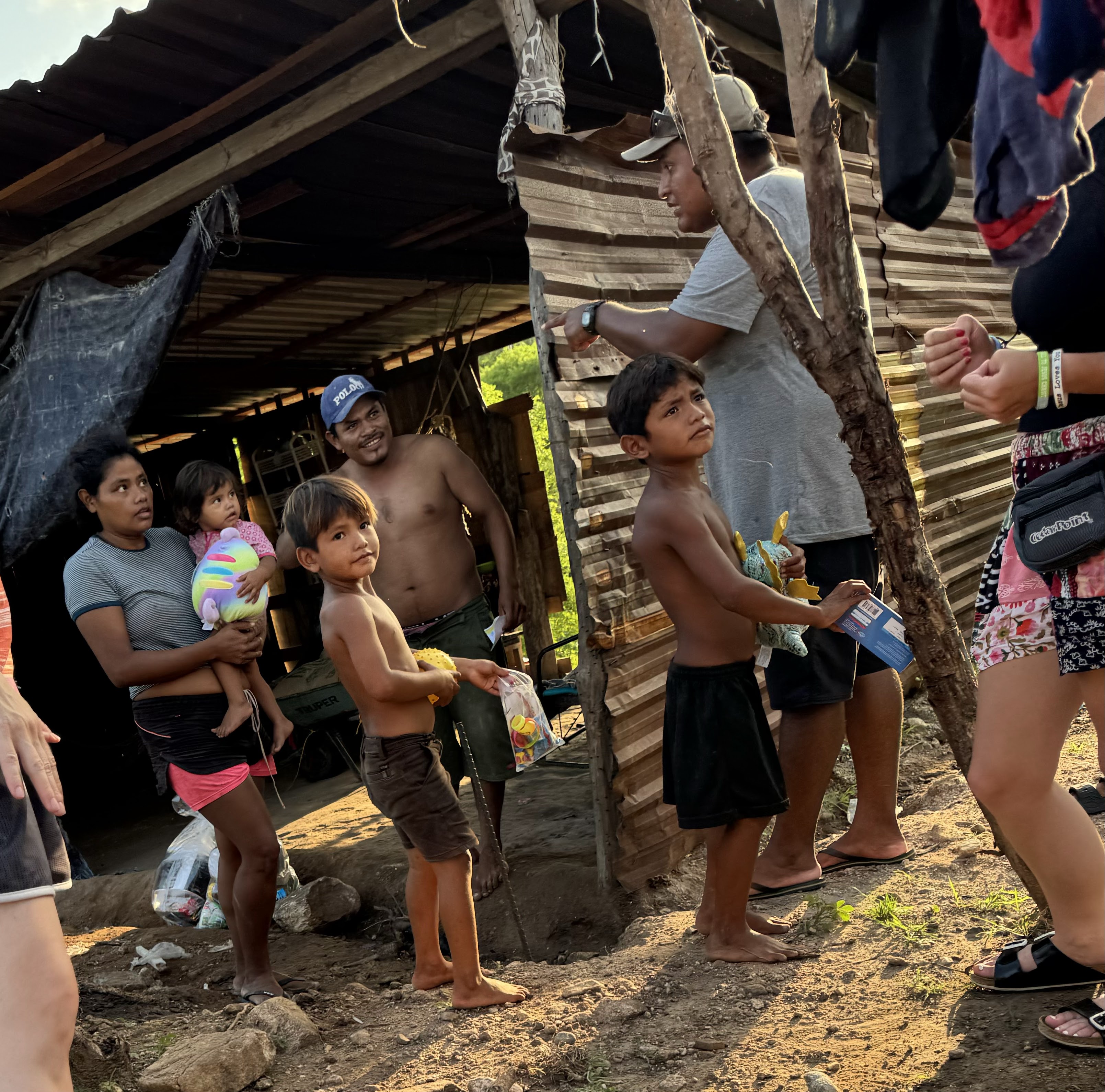
Once Kayla returned, we were able to get all the kids ministry items and gift bags filled and ready. This evening we distributed the food bags, treat bags with gospel tracks, toys, and invitations to the pool day to the local families. (The pool day is where we’ll hang out with the kids, play games and share the gospel through the wordless book.)

As we were driving through the bumpy back roads to get to these people and families, I was reminded of Paul’s words in 1 Corinthians 12:21-22. Here he talks about the church being one body with many members – “The eye cannot say to the hand, ‘I have no need of you,’ nor again the head to the feet, ‘I have no need of you.’ On the contrary, the parts of the body that seem to be weaker are indispensable.” This was our team today, representing the church. The work the men did this morning and afternoon was indispensable. People can now get through on the road to reach church for service on Sunday morning. The work the ladies did this morning and afternoon was also indispensable. The work our team did together tonight connecting with the community, and inviting them to further connections and gospel sharing, could not have happened if we didn’t prepare the packages to give. What a beautiful full circle reminder of the critical role that each of us play in kingdom work when we faithfully answer God’s call.


Brad Again: 


See the guys rested too!


Jocsan took the guys out on a job to repair a road near Casa Ebenezer, where the church will be gathering on Sunday. A few weeks ago, Puerto Escondido experienced heavy rain that devastated some of the roads. Trucks with 4X4 can still navigate the terrain but cars would struggle to get through. We loaded up in the truck and headed to Casa Ebenezer to get some tools. It was amazing to see the continued construction that has happened this year. God has provided for Gabby and Casa Ebenezer, and it was so good for us to see the advancement on the property. After this short stop, we drove back up the road to fix the ruts.  

Jocsan and Gabby directed us to the area. Jocsan is a hard worker and has a vision. It is exciting to watch his leadership continue to grow as God has called him to step out in faith and direct the building of the orphanage and the ministry. He was patient and encouraging all day. Gabby was out helping and encouraging us. Let me tell you, David, Will, and Nick were troopers. I am proud of the way they all jumped in and continued to work hard on a very hot day doing hard work. I grabbed a pickaxe and started loosening up dirt. 5 minutes in I was dripping sweat and feeling overheated. It took a little while, but we acclimated to the day and kept working. I reminded the guys that our devotional theme for the week is from John the Baptist who was the forerunner for Christ. That means it was his job to go before and prepare the way for Jesus the Messiah. The words used in the original language of the Bible, for forerunner, refer to those who would go and build roads for the advancement of the king. So, in a way, we were being forerunners like John the Baptist, preparing the way for the people to come to Church on Sunday and hear the Word of Christ. “So faith comes from hearing, and hearing through the word of Christ” (Romans 10:17). Lord, may it be. 

After we finished the roadwork around 1:30 pm, we were ready for lunch. We loaded up in the truck and began the trek back. Jocsan got a call that a brick delivery truck was stuck at Casa Abba. We stopped by to see if we could help. It was great to see Casa Abba again, but the stuck truck was too big a problem for us. I needed to eat some lunch and the heat starting to get to us all. I was just about to tell Jocsan that we needed to leave when he said, “Come on guys, we need to go.” We had to give up and they called a tractor, and they did get the truck unstuck. 

When we got back to the house, lunch was waiting for us and we had a nice relaxing afternoon to allow the heat of the day to pass. Our day was different than the girls but it was good for the guys. The hard work brought us together and gave us a shared experience, and I was super impressed with Will and Nick’s attitude.  

The evening ministry was designed to help Casa Abba build relationships with its neighborhood community. Any new ministry will encounter suspicion as people get to know the owners and operators. A new orphanage is no exception. Casa Abba’s mission is to be a safe home for orphaned and hurting children where they will hear the Gospel and be loved. It is also to be a place of hope and respite for the community. They want to build inroads into the families and community members by serving their neighbors without expecting anything in return (sound familiar?). 


The purpose of the grocery bags that the ladies put together was to bless the homes of children around the community. Jocsan acknowledged the fact that on our way we would see homes with kids and keep driving, which was hard, but there was an intended area for distribution. The team embraced the mission and prepared to hand out the grocery bags, gift bags with Gospel tracts in Spanish, and toys that each team member contributed. We also had invitations to pass out for our pool party coming up on Monday. Most of the homes we went to cannot afford to go to the pool. Jocsan asked one of the little girls “what is one thing you really hope to do?” and she said, “go to the pool!” Jocsan was excited to have the invitation to tell her that Monday the pool will be free for her. Not only are the kids invited to go swim in the pool but pizza, pop, snacks, and toys will be given out. (Please be in prayer for our Monday pool party as we will be sharing the Gospel with the neighborhood kids using the Wordless Book – Thanks Mom for the training and the supplies!)

Team members acknowledge the excitement to visit the kids and pass out the packs. Several talked about the joy they saw in the children’s faces as they got a gift. Nick was thrilled to give a child the toy he purchased and the excitement the child had as they grasped their new toy. I was thankful to have been there to see Nick’s exchange. I also got to give one of the jumbo matchbox cars I bought to a young boy who had several siblings. He was the oldest and patiently waited making sure his younger siblings had received a toy. I walked up a little later so he thought the toys were out and he was partially hiding his disappointment by standing behind the cistern. I walked around it and did my best to talk to him, I don’t speak Spanish, but some actions and expressions are universal. I showed him the gift was for him and he was so excited! Everything happened so fast that it is hard to absorb all of what happened tonight.  

One young lady, I will withhold her name, shared with our group how difficult it was to see the extreme poverty in real life. She said it is one thing to see it in pictures or in a movie, but it was hard to process the reality of it. It is like you know it exists, but it seems so far away. And then today we encountered it. She is right, it’s hard to fully understand until you're standing in the midst of it. As she shared, it brought back the memories of my first time ministering in the slums of Kenya and experiencing the brokenness of poverty for the first time. Having been to several countries and been to some of the poorest places, it never gets easier. There is too much to process in one evening but it affects you and shapes you.


Another young lady pointed out that, despite their poverty, they were living life and being joyful. The joy of the children and the kindness of the neighbors was beautiful. The Mexican people are hospitable and friendly. If you wave, they wave back. They are genuinely excited to meet you. In America, we become so isolated that we don’t even want to wave to our neighbors let alone strangers. It was as refreshing to see neighborliness as it was hard to see the poverty. I will share one more story shared by Beth, one of Lakeside’s missions committee team members, who has been in contact with Kayla throughout the year and heard about Juan Carlos’s mom passing away and his living with his grandma. She has been praying for the grandmother and the children for months. She had the opportunity to meet the grandmother, Juan Carlos, and Louise tonight. It was an answer to her prayers to be able to encourage her and meet her. How cool is that?! God is so good!

Unfortunately, I cannot write all the comments and all our experiences, but I think this gives you a glimpse into our experience so far.

Well, I must finish up tonight’s post. Thanks for reading and following along. We appreciate your prayers so much! 

God bless.

Thursday, July 4, 2024

Mexico Trip 2024 Travel Day


Travel Day – July 4, 2024
Today was a long day of travel, but it was good. Most of the team set their alarms for 5 something in the morning. If they are like me, they hit the snooze at least once. Somehow it never seems like there is enough time in the morning to get everything done and leave on time, with the “oh am I forgetting something” anxiety looming. Yet we all arrived at the Delta counter in Cleveland at 7:30 am and checked our bags. We were worried about the security line being long on a holiday, but it was the shortest TSA line I had ever seen in Cleveland. We walked right through and had plenty of time to gather ourselves before our first flight.

The flight spacing was timed just about perfectly. Plenty of time to get where we needed to go, and the layovers went by fast. 4 cities, 3 planes, 2 layovers, and 11 hours later we arrived here safely. Praise the Lord! Traveling together is a great bonding experience and good conversations have already begun. However, it was a long day and there is a 2-hour time difference. We arrived at this amazing AirBnB that God provided and had some pizza and tacos for a late dinner.


It was wonderful reuniting with Kayla and Jocsan Morales and their family. Zeke is precious and it was a joy holding him for the first time. It was a beautiful beginning to our trip. 


Right after pizza and tacos, some could not resist jumping in the pool immediately after. I looked around and saw some dirty dishes and thought about Christ’s example of washing feet. This is a good opportunity to lead with a towel. I picked up one dish after another and began washing plates, bowls, and cups. Kayla Kemer saw me doing the dishes and joined me in serving. This is the kind of thing I like to do to challenge my inner pride. It can be tempting to think that I deserve to sit and relax because I am leading this trip. Yet, that is not what my Savior did, he washed feet.

Jesus said, “But whoever would be great among you must be your servant, and whoever would be first among you must be your slave, even as the Son of Man came not to be served but to serve, and to give his life as a ransom for many” (Matthew 20:26–28 ESV). Jesus’ upside-down kingdom can seem at odds with what comes most naturally to our understanding, but following his path leads to life, abundant life (John 10:10). This is what our theme devotional is all about on this trip. John the Baptist stated, “He must increase, but I must decrease” (John 3:30).

Whether you are on a mission trip or at home if you are a follower of Christ you are called to serve. It sounds exhausting and crazy, but you will find it to be so rewarding and rejuvenating when you serve others like Christ. Tim Keller wrote a short booklet called The Freedom of Self Forgetfulness, where he discusses the Christian’s motive for being a servant,

“Do you realize that it is only in the gospel of Jesus Christ that you get the verdict before the performance? The atheist might say that they get their self-image from being a good person. They are a good person and they hope that eventually they will get a verdict that confirms that they are a good person. Performance leads to the verdict. For the Buddhist too, performance leads to the verdict. If you are a Muslim, performance leads to the verdict. All this means that every day, you are in the courtroom, every day you are on trial. That is the problem. But Paul is saying that in Christianity, the verdict leads to performance.”

In God’s economy, you don’t serve others to gain favor with God. Instead, when you are In Christ you are made new by the finished work of Christ, and from a grateful heart, you live like Christ. We want to learn how we are to decrease in a way that causes Jesus to increase in our present circumstances. Pray for us this week as we will be challenged to decrease, humble ourselves, and serve others in the name of Jesus.

Wednesday, June 26, 2024

Restores my soul - Psalm 23:3


Psalm 23:3

He restores my soul. He leads me in paths of righteousness for his name’s sake.


“As we continue in Psalm 23, notice that these first 3 verses describe what the Good Shepherd is doing for us. He is the one working and we are the ones receiving the blessings from his work. He leads us for “his name’s sake” meaning according to his character, his holiness, and his loving kindness. Following him leads us down the righteous path. Staying close to him brings restoration, refreshment, and revitalization to our souls. Today I am praying that you trust the Good Shepherd with the next step down the path of righteousness and that his presence revives your soul!


This was the text I sent out to my weekly prayer text list (if you’d like to be on it text me at 330-322-3232). I began a weekly text to my small group of youth group guys over a decade ago. I then added my new small group of guys. Then I added a few people I was trying to encourage. During the pandemic year of 2020, I added the entire youth group and all the youth group parents. I also included my family. Occasionally I will include the option to opt out of the texts by simply texting “STOP” but very few have canceled. I am grateful for the opportunity to see the individual names and pray for the people on my list. Each week I look up a Bible verse and try to develop a meaningful devotional thought that is short enough for a text. I also like to think of an application prayer to include. These are expressions of my personal devotions that I share with others.


I am thankful for what God led me to see in Psalm 23:3 in this text. Even as I was preparing the lesson for tonight, stopping and reading this reminded me of the important truth that our Good Shepherd is the one who works, and we receive his blessings. When we follow the Good Shepherd, Jesus Christ, we can be certain that he will fulfill what he promises for “his name’s sake.” He is YHWH, the faithful covenant-keeping God, and he cannot fail. So far we have talked about Jesus being our shepherd who ensures we will lack for nothing, we will have enough, our daily provision, and he gives us the Holy Spirit, the Living Waters.


Following Christ is an invitation to have your soul restored.


What do you think “restores my soul” means? The Hebrew word literally means to “put back together.” Pause and think about that truth.

Do you remember the nursery rhyme “Humpty Dumpty”? “Humpty Dumpty sat on the wall, Humpty Dumpty had a great fall, All the kings horses and all the kings men, could not put Humpty Dumpty together again.” By Mother Goose.


Whatever the real story is behind the creation of this rhyme, it presents us with a good illustration of the effects of sin. When Adam and Eve rebelled against God in the Garden, all of humanity became “Humpty Dumpty having a great fall.” Relationship with the Creator was broken, and the image of God was tarnished. Despite all of man’s efforts and even the earthly kings’ resources, we cannot repair our brokenness caused by sin. We need a Savior.


Yet our Good Shepherd “restores our soul!” He brings forgiveness and turns us around and puts us back together. When we place our faith in Jesus Christ and follow him as sheep follows her shepherd, we receive restoration of our souls. He is in the act of putting us back together (2 Cor. 5:17).


Following Christ is an invitation to walk in the Light.


He leads me in paths of righteousness…


I recall the prophet Jeremiah’s proclamation: Jeremiah 6:16

Thus says the LORD: “Stand by the roads, and look, and ask for the ancient paths, where the good way is; and walk in it and find rest for your souls.


Do you hear the call to walk the righteous paths here? It is the good way. It is God’s way. When you follow the shepherd, you will receive what? Rest for your soul.


If I told you that there was something simple you could do beginning today to bring more rest in your life, to calm your anxieties, to alleviate depression, and to give you more hope, would you do it? Of course, you would say yes. If it was the simple thing to do was to take a pill twice a day for those benefits, would you do it? Of course. You’re an American and we love to pop pills.


Here is the truth, you can have those benefits for real, if you avoid social media for a whole week. Studies show that avoiding social media for a week will demonstrate a noticeable reduction in stress, anxiety, and depression. Yet every time I tell the students to avoid it they respond the same way the Israelites did to Jeremiah,


But they said, ‘We will not walk in it.’ (Jer. 6:16).


God called them to follow the Good Shepherd and receive the benefits of his loving kindness and the refused. Where is your heart today? Are you willing to follow his ancient paths, the paths of righteousness?


Our Good Shepherd, Jesus, said it this way,


“Come to me, all who labor and are heavy laden, and I will give you rest. Take my yoke upon you, and learn from me, for I am gentle and lowly in heart, and you will find rest for your souls. For my yoke is easy, and my burden is light” (Matthew 11:28–30).


There is no downside for following Jesus. Yes it may seem costly because he wants you to rely on him for your daily needs and he wants to lead you away from the earthly comforts that so easily distract you from his loving kindness. But what you reap is far more than what you sacrifice.


“Restore my soul” also means forgiveness of sin. In John 8:1-11, a woman caught in adultery is brought to Jesus to be punished by stoning. This whole scenario was a setup to try to trick Jesus. However, the Good Shepherd surprised everyone by stating, “he without sin should cast the first stone.” Even the most self-righteous religious leaders had to admit they had sinned, and one by one they walked away. When Jesus talked with her, he saw her as a person and had compassion for her. He exhorts her to “go and sin no more.” Essentially, he sent her away on the “paths of righteousness.”


Immediately following this exchange, Jesus turns and says, “I am the light of the world. Whoever follows me will not walk in darkness but will have the light of life” (John 8:12).


Following the Good Shepherd is to follow the Light of the world. As we walk in the light, he illuminates our steps.


David said it this way, “Your word is a lamp to my feet and a light to my path” (Psalm 119:105). Like the green pastures, the light he provides is for the next step. He doesn’t show us the blueprints for our lives, or the 5-year plan, but he shows us enough to trust him and follow him.


His plan for us is to walk in the paths of righteousness and to forsake sin. The Bible gives us directions for walking on these ancient paths. “How can a young man keep his way pure? By guarding it according to your word” (Psalm 119:9). “I have stored up your word in my heart, that I might not sin against you” (Psalm 119:11). To follow the Good Shepherd, we need to hear his voice and commit it to memory by spending time in the Scriptures. Guard your life with the truths of Scripture. Memorize the Word in your inner self so that you will have it to use as your defense against sin in your time of need.


The Good Shepherd is leading you, caring for you, and restoring you to his original design, to be in a right relationship with him. Trust him. Listen to his voice. Follow.


Wednesday, June 12, 2024

The Way of the Shepherd - Psalm 23:1


This video helps give us the context of understanding Psalm 23:


 Read Psalm 23:1-6


Title: “I Am the Good Shepherd”


Psalm 23:1

The LORD is my shepherd; I shall not want.


Let’s just look at the verse, what stands out to you? It’s only 9 words but what do you see?


Here is a few of my observations:


A.    LORD is in all capital letters.

B.    The LORD is described as a shepherd.

C.   The shepherd is MY shepherd, a possessive term.

D.   Because B my needs are provided for.


These are four good observations. Let’s unpack them.


A.    Whenever we see LORD In all capital letters, we know it is translating YHWH, Hebrew name of God revealed to Moses (Ex. 3:13-15). Yahweh is the personal name of God revealed in the Old Testament. As God reveals his name to Moses he is emphasizing that he is the self-existing creator and sustainer of everything that exists and sovereign over all of history. His very name proclaims that he is the “one true God.”

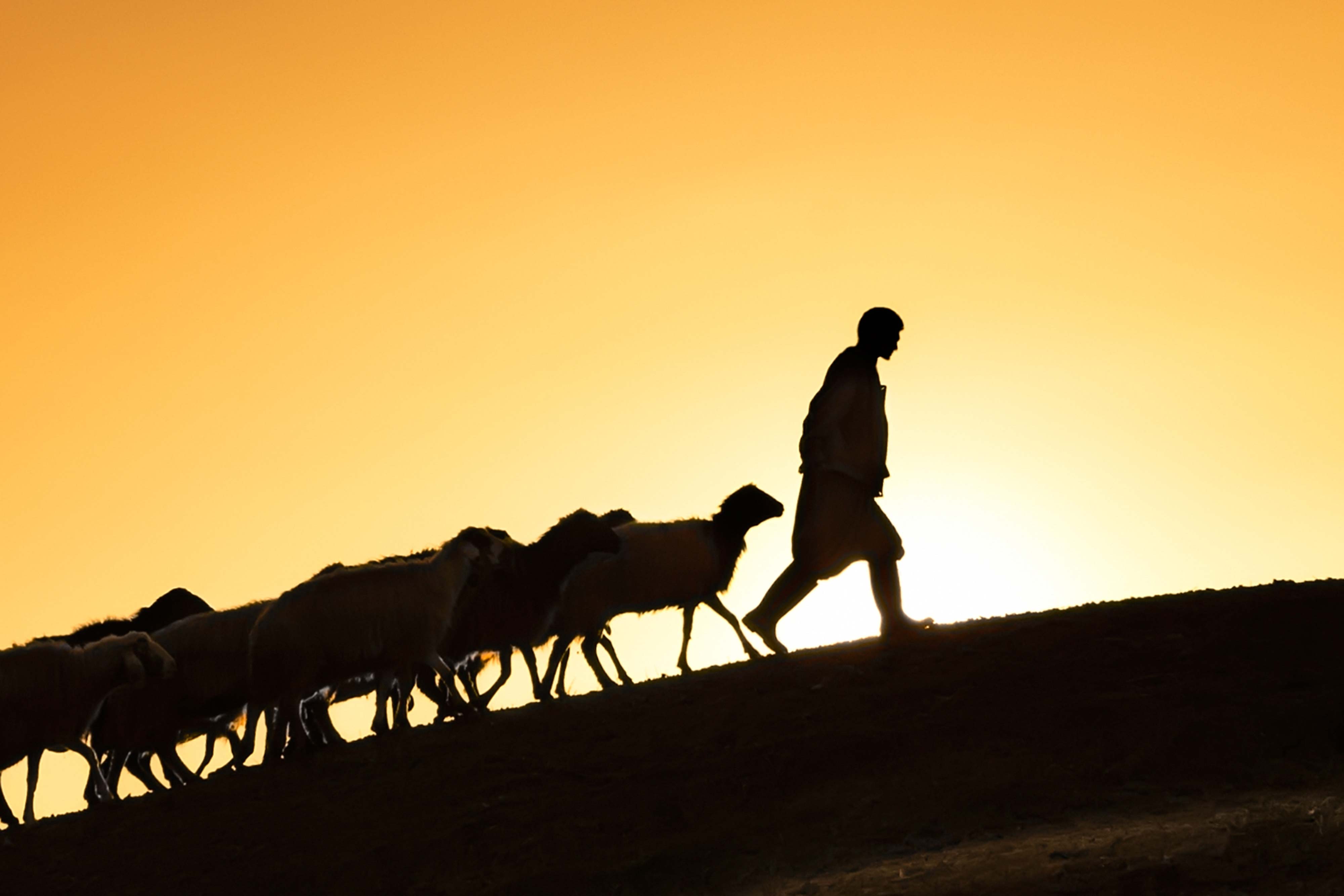
B.    Shepherd is a role very familiar to David as he began as a shepherd of his father’s sheep. How do you envision the role of a shepherd? David, having lived the life of an Ancient Near Eastern (ANE) shepherd would have had very tangible ideas for him to describe God as a shepherd. The modern Bedouin shepherds are the closest example of an ANE shepherd we have today. A Bedouin shepherd does not drive the sheep but leads them and they follow. A Bedouin shepherd’s primary concern is the welfare of the flock and due to the mountainous wilderness terrain, they are constantly on the move for food and water. The LORD as Shepherd is concerned about the welfare of you and me. We will be unpacking his provision and protection throughout this series.

C.   David describes the LORD as “my shepherd,” a possessive term that describes a relationship (John 10:14, 27). A Bedouin shepherd spends time with their sheep, talking over them, and singing to them. The sheep trust their shepherd and follow his voice. As shepherds gather in the wilderness and their flocks mingle together, the shepherds do not worry about losing their sheep to another shepherd. Why? Because his sheep know his voice and when it is time to leave, he will sing their song or call out to his sheep and they will follow him. A relationship with the LORD as your shepherd means you will trust and follow his voice.

D.   “I shall not want,” or “I will not lack,” means everything I need is provided for me by my shepherd. The Bedouin shepherd in the wilderness provides the context for understanding this psalm. The shepherd leads the flock to the place of provision for their daily needs. Not tomorrows, but today. Following the shepherd daily is enough for what you need today. “Want” can be misunderstood to think of an overabundance rather than the essentials. “I shall not want/lack my daily supply” is what is intended here. There is a difference in our understanding of “want” and “need.” Often I have to correct people when they say, “I need __________!” You fill in the blank, but the express a desire of something they want to have, but they really don’t need it. “I need the new Xbox” or “I need the new iPhone” are examples of desires that are not necessary. God promises to meet our daily needs and sometimes he grants us our superfluous desires as a provision of his kindness to us. However, in our prosperity we need to be cautioned against taking our eyes off of the Shepherd for our daily needs.


In conclusion, Yahweh is a relational God who set his affection on his sheep and promises to provide daily needs and protection to his sheep.


Side Note:

One more historical note about the ANE understanding of “shepherd.” Although David, who was a shepherd, uses the pastoral language of a Bedouin shepherd with his sheep, he is also speaking to a big reality that is not as transparent to our modern readers. “Shepherd” is also a term used in the ANE for a Divine King. The Egyptians despised shepherds, yet they adopted the hieroglyph of a “Shepherd’s staff” to represent the divine pharaoh, their king who thought he was a god. Other nations would call their leader a shepherd king when they began to believe he was a god. The ANE people would readily recognize the double meaning of the phrase. In a very real sense, king David is saying that Yahweh is his God and King, he is a Divine King who cares for his kingdom.


As we continue to study Psalm 23, we will see how Jesus Christ is the ultimate fulfillment of these verses.


Jesus said, “I am the good shepherd. I know my own and my own know me” (John 10:14). Do you see how Jesus just claimed to be God? Psalm 23 “The LORD is my Shepherd” and Jesus’ “I am the good shepherd” put together is in essence Jesus saying, “I am Yahweh.” Including the kingship language of shepherd, Jesus is claiming to be the divine King and LORD. He also includes his relationship with his sheep. “My sheep hear my voice, and I know them, and they follow me. I give them eternal life, and they will never perish, and no one will snatch them out of my hand” (John 10:27–28).


When you choose to follow Jesus Christ as your Shepherd, you are acknowledging that you need to follow him for your daily needs. You need to follow him for your salvation. He is King. He is God. And he is enough. Not only does Jesus promise to lead you to your daily provision and protect you, but he promises to forgive and save those who believe (John 1:12; Rom. 10:9-10). He promises eternal life (John 10:10, 27-28), that starts now and last forever. Jesus is clear that his sheep belong to him and are eternally secure in him.


Jesus is the LORD, who is my shepherd and king, and because he died, was buried, and rose again, I have everything I need in this life (daily) and the next (eternally). Do you believe that?  


Hebrews 13:20–21

Now may the God of peace who brought again from the dead our Lord Jesus, the great shepherd of the sheep, by the blood of the eternal covenant, equip you with everything good that you may do his will, working in us that which is pleasing in his sight, through Jesus Christ, to whom be glory forever and ever. Amen.

Wednesday, May 29, 2024

Schools Out

The anticipation was building all week but is finally just moments away. The final bell is about to ring in the end of school and the beginning of summer break! Our school tradition was to run out in the hall and throw all our papers in the air and clean out our lockers. The hallway was chaos but so fun as we threw paper at each other and joking around while sliding down the hall on the loose paper. (Hmm I did not appreciate the janitorial staff as much as I should having to clean up our mess!)

Finally free of the schedule, the routine, and the homework. My days were mine and I could do whatever I wanted to do. But how quickly this new freedom turns into boredom and missing my friends. Do you know what I mean? Summer is full of free time and vacations, which is good, but it can also be bad.

What are you going to do with your summer? 

Summer can be an amazing break, or it can be a stumbling block, it just depends on your perspective and your plan. School can be demanding but routine is good. What happens when routines are broken, and expectations are lowered? You will either choose to rest or be idle.  As you consider your summer break, I want to encourage you with a few verses to be faithful in your walk with Jesus.

Choosing Rest

Hebrews 10:23–25

23 Let us hold fast the confession of our hope without wavering, for he who promised is faithful. 24 And let us consider how to stir up one another to love and good works, 25 not neglecting to meet together, as is the habit of some, but encouraging one another, and all the more as you see the Day drawing near.

There is a lot to unpack in this short passage, but I want to leave you with a phrase to summarize this: on your summer vacation, don’t take a break from God. With your extra time will you consider holding fast, encouraging, and engaging community. 

Be Determined

The author of Hebrews encourages us to “hold fast the confession of our hope without wavering.” I love the fact that God’s Word encourages us in our weakness. These words acknowledge the struggle of remaining faithful and overcoming doubts. It’s important to recognize your humanness (Psalm 103) and be prepared to fight the good fight. Be determined to stick with Christ because “he who promised is faithful.” God’s faithfulness to us is a motivation for our faithfulness to him. 

Be Purposeful

You have a purpose given to you by God to be an encourager to fellow believers. Did you know that? How are you stirring up a deeper love for God in others? How are you encouraging others to do good works? Most of the time, when we stir something up, we tend to get in fights or arguments. That’s not our purpose. Our purpose is to encourage and exemplify godliness in our friends and families. 

Be Committed 

Commit to meeting together with other Christians. Most commonly we know this as attending church and youth group. You need fellow believers in your life. You need the Christian community. God wants you to commit to a local fellowship, it is his gift to you. You not only need it, but it needs you. You have something to offer by being there. Sometimes it may be expressed in a public way (like singing, teaching, serving) and other times it is just being present. Both ways matter.

Obedience to God invites his supernatural power to interact with our lives. As the early church father IGNATIUS said, “When ye frequently, and in numbers meet together, the powers of Satan are overthrown, and his mischief is neutralized by your likemindedness in the faith.”

Coming together with other believers who testify to the truth of God empowers believers to overcome the temptations of the enemy. Sure, there is no perfect church, but when we are determined to hold fast to the truth, purposeful in our engagement, and committed to our community we will see God do some amazing things in our midst. 

Choosing to be Idle

There is nothing worse than being exhausted from doing nothing. Have you had a day or season like that? Waking up and watching movies all day and feeling lethargic and tired even though you haven’t moved? On occasion that might be okay, but did you know it’s dangerous? Idleness is not a virtue, it’s a breeding ground for sin. 

You probably have heard the phrase, “Idle hands are the devil’s playground.” Although that is not a direct quote from Scripture, it does summarize some of the biblical warnings of idleness. 

Proverbs 16:27

A worthless man plots evil, and his speech is like a scorching fire.

A person with nothing to do finds himself plotting evil. Paul warns about “busybodies” who aren’t working but getting into other people’s business (2 Thess. 3:11). Paul also has some strong words for Timothy about not enabling those who can find ways to provide for themselves lest they become idle busy bodies. “Besides that, they learn to be idlers, going about from house to house, and not only idlers, but also gossips and busybodies, saying what they should not” (1 Timothy 5:13). He is not being harsh; he is identifying a common temptation for us when we don’t have anything to do. We get into others business and stir up strife. 

About a month before I went to Nairoby, Kenya, there were riots in the very slums where we were going to visit. Buildings were destroyed and thousands of people lost their lives. What motivated these riots? Idle men who had nothing to do, decided to pick a fight and it spiraled out of control. Innocent lives were lost, and homes were ruined because of a few who chose idleness over purposefulness. 

Consider what happened to King David when he took a break that he wasn’t supposed to take. 

2 Samuel 11:1–5

1 In the spring of the year, the time when kings go out to battle, David sent Joab, and his servants with him, and all Israel. And they ravaged the Ammonites and besieged Rabbah. But David remained at Jerusalem.

2 It happened, late one afternoon, when David arose from his couch and was walking on the roof of the king’s house, that he saw from the roof a woman bathing; and the woman was very beautiful. 3 And David sent and inquired about the woman. And one said, “Is not this Bathsheba, the daughter of Eliam, the wife of Uriah the Hittite?” 4 So David sent messengers and took her, and she came to him, and he lay with her. (Now she had been purifying herself from her uncleanness.) Then she returned to her house. 5 And the woman conceived, and she sent and told David, “I am pregnant.”

We will stop there, but you can read the rest of the story later. David took a break and became idle. Taking a break to rest is good. Neglecting what you should be doing and becoming idle is not. In David’s idleness he proved the axiom “idle hands are the devil’s playground.” See the progression, David stopped, saw, sent, took, and later we would see he killed. 

Idleness leads to waywardness. It can start by scrolling through Instagram reels, one right after another. It may start off innocent with puppies and pranks, but then a tempting reel pops up. It puts a thought in your mind. Now you want to pursue that thought. You may not take it to the extent David did, but you started down the same road of sin. 

Sin is insanity. It blinds you to what is really going on. David never intended to sleep with his friend’s wife and plot to kill him. He got caught up in his sinful episode that took him farther than he wanted to go, kept him longer than he wanted to stay, and cost him way more than he wanted to pay. It wasn’t until the prophet Nathan confronted him and David repented that his sanity was restored to him (Psalm 51). 

This story of David reveals the truth written in Proverbs:

Proverbs 29:18

Where there is no prophetic vision the people cast off restraint, but blessed is he who keeps the law. (ESV)

Before I comment, I thought we could read The Message’s rendering:

Proverbs 29:18 (MSG)

If people can’t see what God is doing, they stumble all over themselves; But when they attend to what he reveals, they are most blessed.

When we take a break from God, we forget what his Word tells us and we do stupid things. When we are purposeful in engaging our relationship with God and walk in obedience, we are promised blessings. 

I don’t like missing Sundays or Wednesdays at Lakeside/LOFT. It’s my local community, my family, and one of the ways I feel most connected to God. However, when I vacation or take a sabbatical, I make it a point to attend church with the people of God. Sometimes I have no idea who anyone is at a new church, but I am with people who believe what I believe and worship the same God. Since I have vacationed in the same spot for several years and have attended the same church in that city, I now have friends who recognize me there and I have fellowship with them on vacation. I enjoy visiting them, but my heart longs to be back home with Lakeside and LOFT. 

Unfortunately, we do not have a 24/7 opportunity to attend church gatherings, so it is important to establish good spiritual disciplines and practices throughout our days and weeks to engage our faith. You should set goals for your summer and seek to redeem the time. With your extra time, try reading more Scripture, memorizing it, praying longer, reading good Christian books (I can recommend a few). Look for ministry opportunities and seek to share your faith. 

We come back to Hebrews 10:23-25: be determined, be purposeful, and be committed. This is how you avoid idleness and understand what rest truly is. 

Matthew 11:28–30

“Come to me, all who labor and are heavy laden, and I will give you rest. Take my yoke upon you, and learn from me, for I am gentle and lowly in heart, and you will find rest for your souls.For my yoke is easy, and my burden is light.” 


Wednesday, May 15, 2024

The Potter's Wheel


We have just finished the Great Chapter 8, which summarizes the work God does on behalf of the Christian, we now enter one of the most difficult passages of Scripture in Romans 9. Studying the book of Romans is deep and can be difficult at times because there is so much to wrestle through as our human finite minds try to comprehend the redemptive plan of an infinite God (I find it fun). We find great comfort in the promise that “there is now no condemnation for those who are in Christ” (Rom. 8:1), and “the suffering of the present time is not worthy of being compared to the glory to be revealed in us” (Rom. 8:18), and “for those who love God, all things work together for good, to those who are called according to his purpose” (Rom. 8:28), and “we are more than conquers” (Rom. 8:37), and “nothing can separate us from the love of God” (Rom. 8:38-39) to mention a few.


The difficulty often arises with some theological words like foreknew, predestined, called, justified, and glorified. (These are amazing and deep, and I encourage some good theological play in discussions about them.) Understanding these concepts has been a major discussion for over 2,000 years by some of the greatest thinkers and continues to be a topic worthy of wrestling through, so do not feel pressured to feel like you have it all figured out. How we interpret these texts depends on our faith background, theological influences, and our own spiritual development and journey. The most important thing in discussing theology is to remain humble, teachable, and loving. Most of the discussions regarding the interpretations of this text are among fellow believers, meaning it is a family discussion. The fact that these concepts and passages provoke emotional responses and pique our insecurities should remind us to remain humble in our discussion. When we come to Scripture, we will encounter truths too deep for us to comprehend because they reveal a God who is beyond our comprehension. Yet, what he has revealed to us is sufficient for us to place our faith in him. We are on a journey with our brothers and sisters to understand our God deeper and fuller. If you are excited about Romans 9 and love the chapter, or if you are confused by it and cannot understand parts of it, or if you would rather just avoid it, I hope that our discussion today will invite you into a deeper understanding of God and his plan for your life.


Read Romans 9:1-29


What stands out to you? What questions come to mind?


It’s good to wrestle through the text yourself before engaging in debates or commentaries. Allow the Holy Spirit to reveal the questions or answers you are seeking.


Let’s look at the bookends of our discussion today: Rom. 9:1-5 and Rom. 9:25-29.


This section starts with Paul’s passion for lost Israel.


Book End 1: Passion for the Lost: Rom. 9:1-5


Paul so desperately wanted his fellow Israelites to know Jesus that he had “great sorrow and unceasing anguish” in his heart for them. Do you ever have sorrow or anguish for the lost in your family, neighborhood, school, or workplace? What does that even mean? I was challenged by Francis Chan’sstory when he was preaching on this passage. He recounted a time when he watched his grandmother slip away into eternity without knowing if she was a believer or not. It wrecked him. He describes the anguish he felt from the loss and how it turned into a passionate plea to his brother about trusting Jesus. The lost are heading to a real Hell and eternity matters. That is why we must preach Jesus Christ, crucified, buried, and risen.


Greg Stier, from Dare2Share ministries, talked about going to the mall to people-watch. Well, more than people-watch, he imagined a sign on their foreheads that said: “lost”. As he began to realize how many people walked by that were heading to hell it provoked a deep sorrow in his heart and an urgency to evangelize. That is how Dare2Share began, a young man developing a passion for the lost.


Paul’s zeal for the truth never eclipsed his passion for the lost. As you read Romans 9, understand it is written by one of the greatest evangelists of all time who traveled through hardship and pain to deliver the Gospel of Jesus Christ to the lost of the world. It is through the message of Christ (Rom. 10:17) that God’s grace and mercy are revealed.


Bookend 2: God’s Grace and Mercy Revealed: 9:25-29


Have you read the book of Hosea? Do you know the story? Paul refers back to Hosea here, but we must understand what Hosea went through to understand the implications of these statements. Read Hosea 1- 3. I wish I could take time to unpack Hosea here, but you can read what I wrote about the story previously in An Outrageous Request and Better Than I Deserve.


Hosea was told to marry an unfaithful wife as an object lesson of Israel’s unfaithfulness to God. Their children’s names meant “judgment is coming,” “not my people,” and “no mercy.” These were children born from unfaithfulness and rebellion. Sin separates us from God and removes the blessings of God. But Jesus went to the cross to pay for the judgment we were owed. Being in Christ means those who were once not his people are now his people, and those who did not receive mercy, now receive mercy.


When Paul refers to this in Romans 9, he is telling us about the heart behind God’s redemptive plan and purpose for election. We see it both in Paul’s passion for the lost, which God’s passion is even greater than Paul’s (2 Pet. 3:9). And we see it in the grace and mercy for those who were once not his people are being drawn into his family (Rom. 9:26). This is God’s purpose for election.


God’s Purpose for Election: Romans 9:6-18


Election simply means to choose. Election, or choosing, is throughout the Bible. For our study tonight, we are just going to understand the fact that God has a chosen plan for history and redemption. We will not try to understand the mechanism but explore the reality. God chose Abraham’s family to be the people who carried along the promises of God for the redemption of all mankind. Although God elected Abraham, not all of his children were a part of the promise. Paul further demonstrates that not all who were born Israelites truly belonged to Israel, or people of promise. The description of those who do not belong are called “children of the flesh” and those who do belong are “children of the promise.” The evidence of election is based on faith in Christ and trust in the promises of God. Those who do not believe in God or try to work for their salvation are missing out on the promise. Paul refers to four examples to tease this out.


Four Examples


Abraham and Sarah – God promised Abraham and Sarah a son in their old age. Isaac is the son of the promise. God chose Abraham and Sarah for the promise, he chose Isaac, before he was born, to be a partial fulfillment of the promise and the one to carry on the promise through his family.


Isaac and Rebekah – God chose to carry on the promise through one of Isaac and Rebekah’s sons. Before they were born, God said the “older will serve the younger,” implying the younger son will be the carry of the promise (Gen. 25:23). Understand, Jacob did not outperform Esau for the right to carry the promise, God chose him before they were born. It was not because of works or worthiness. Just like when we come to salvation today, we cannot do anything to earn our salvation, it is only because of God’s free will to save us through the provision that he has made in Christ Jesus.


Jacob and Esau – When Paul says, “Jacob have I loved, but Esau I hated,” he is referring to Micah 1. As we consider this hard saying we do not hesitate with the “Jacob have I loved” part because God is love. It’s the “Esau have I hated” that we struggle with. We are talking about the promised covenant of God through Abraham being passed on through one family line, which ultimately will be the line that the Messiah, Jesus Christ, is born into.


The word for “love” here in Hebrew means “choosing covenant faithfulness.” When looking back at Malachi and the rest of history, God has demonstrated a conscious willingness to act on behalf of Israel, repeatedly and faithfully. This does not mean that he did not punish Israel but that he will not give up on Israel.


Whereas the word for “hate” does not mean considered worthless but rejected regarding the promise. In Malachi 1, the prophet declares the word of the Lord to punish the nation of Edom (the descendants of Esau) for their sins and mistreatment of Israel. The destruction they would endure would demonstrate God’s greatness in the world (Malachi 1:5).


This phrase “Jacob have I loved, Esau have I hated,” is used by Paul to demonstrate how God’s purpose of election has been passed on through Abraham, to Isaac, and then to Jacob, not to Jacob’s other son Esau. It should be clear that God’s rejection of Esau/Edom does not mean the individuals from Esau’s line cannot find redemption in the promises of God, but it is through the line of Jacob that Jesus would bring salvation to all who believe.  


Pharaoh – Paul’s fourth and final example we will look at is found in the ruler of Egypt, Pharaoh (Ex. 7-11). God told Moses that he would choose who to have mercy on whomever he pleases. As we read the story of the Exodus, Pharaoh refused to hear the message of the Lord through Moses. Seven times he had the opportunity to repent and obey God’s commands, but he refused and hardened his heart. Then, some of the saddest words in Scripture take place, “the Lord hardened Pharoah’s heart” (Ex. 10:20, 27; 11:10). Pharaoh was cut off for the purpose of showing the mighty name of God through all the earth (Ex. 9:16, Rom. 91:7). This leads Paul to declare that God has mercy “on whomever he wills” and God hardens “whomever he wills.”


This truth is played out throughout the Bible. Pause for a moment and create a list of those who were unlikely but received mercy and those who were hardened, some of them surprising.


Received mercy – Jacob, Rahab, Ruth, Nebuchadnezzar, the Centurion

Received hardening – Pharaoh, Judas, Herod, the Pharisees


In that short list, we see the examples of God’s choosing some and passing over others. This is a hard truth to understand.


This is Tough: Romans 9:19-24


As Paul is writing this teaching, he anticipates people’s pushback. This is hard to understand. Paul knew it would be hard but being hard to understand does not mean it is not true. If we were to try to iron out the mechanism of this teaching we can end up in very different camps, but we have to acknowledge that what has been said is in the Bible and has been recorded for us to humbly come to and trust God.


Paul follows God’s pattern in the book of Job (Job 38-42), by asking some rhetorical questions about the potter and the clay. Does the clay have the right to question the potter’s choice? Does the clay have the right to question the potter’s use of the clay?


I am thankful Paul uses this illustration of a potter and the clay. Have you ever seen the process of making a vessel out of clay? The potter first must soften the clay to make it formable. He then throws it onto the potter’s wheel and spins it at high rotation. As it is spinning, the potter can easily mold it into something. Trying to understand all of this and wrap our minds around these teachings can feel like we are spinning round and round on the potter’s wheel. Be patient and trust the Potter, for he is forming something in you for his glory and your greatest good.


Here is what we do know God has chosen a redemptive plan and purpose that he has been working out throughout history. Jesus Christ is the ultimate fulfillment of the promise given to Abraham, Isaac, and to Jacob. He has been faithful to that promise to bring to pass the birth and life of Jesus. Jesus fulfilled the Law, which Israel (and all mankind) was unable to fulfill. Jesus went to the cross to pay for our sins and provide a way of salvation for all those who believe. Thereby he is both the just and the justifier of those who believe. In God’s sovereign choice, he called the Jewish people, but he also called out some from the Gentile nations.


This chapter helps us see that in God’s redemptive plan, he has a passion for the lost, a plan for the lost, and he has grace and mercy on the lost who believe. Our humble approach to this tough topic is to be the clay that simply trusts the Potter to do what is best for his glory and our greatest good.


Wednesday, May 1, 2024

The Good


He saw the fear in their eyes as they took anxious breaths. They did not understand the significance of the events that had led to this moment. Sure, they tried to live good lives and make up for their past mistakes, but the one sin they all conspired to commit was huge. He empathized with their panicked pains and worries and was tempted to let it linger, however, he quietly thanked God for giving him an eternal perspective based on faith in the promises of God. Faith in God gave him hope that allowed him to persevere through rejection, servitude, and prison with a positive mindset and a faithful life. Hope is powerful! Not only were they mourning the death of their father, but they feared for their lives. He compassionately began to say, 


Do not fear, for am I in the place of God? As for you, you meant evil against me, but God meant it for good, to bring it about that many people should be kept alive, as they are today” (Genesis 50:19–20).


In this vignette from the life of Joseph, we see exactly what Paul is talking about in Romans 8:28, and really the whole section. Joseph saw beyond his present circumstances to something beyond his own experience, believing God was working a bigger story than his own struggles. His statement to his brothers reveals his belief in the sovereign hand of God working behind the scenes to bring forth good for his people. Keep this in mind as you read through the passage.


Read Romans 8:18-30


Future Glory – Romans 8:18-25


In this section, Paul is calling us to look beyond this temporal, present time. To look beyond our current suffering. He is not dismissing the reality of suffering or the realness of the pain we feel going through it. However, in light of eternity, what we are enduring in this moment is like comparing one grain of sand with the beaches of the world. Having an eternal perspective transforms the way we think about hardship (2 Cor. 4:17). What we face today is not worth comparing to the hope we have in the future, which is yet to be revealed. I love this verse, Romans 8:18, and find myself quoting it and reflecting on it often. What is this glory to be revealed “in us”? 


It is the “redemption of our bodies” (v. 23) as adopted children of God. Paul is speaking of the “already not yet” aspects of our faith. In Christ, we are adopted and redeemed spiritually. Here Paul tells us that one day our bodies, and all of creation, will be redeemed. The curse will be lifted, and sin and corruption will be done away with. I find it interesting to read that “not only creation…groan” waiting for our adoption. The relationship that humanity has with creation is significant and worthy of exploring deeper than the few comments I will make here. 


God made all of creation a special place for humanity to live. God spoke creation into existence out of nothing (ex nihilo) and from creation he formed the first man, Adam. In Hebrew, the word for earth is adama and the word for man is Adam. From the dust of the earth, man was formed in a unique relationship. When Adam sinned, a curse was brought on all of creation, and since that time creation has groaned for freedom from the curse. The groaning of creation and our souls is likened to the groanings resulting from childbirth. That is deep, intense, visceral groans through pain that results in the birth of a child. Likening the groanings to childbirth also gives the implication that there is something being delivered, hope. Creation is longing for us to be in our glorified, adopted, and redeemed bodies, free of the curse. A return to Eden without sin, where once again God, man, and creation will be reconciled and restored. Just something to think about.


Present Help – Romans 26-27


An eternal perspective helps us through our trials, but God has given us more than the hope of final redemption in the future; he gives us His Spirit to empower our present. The Spirit helps us presently in our weakness. Right after mentioning weakness, Paul mentions prayer. Not only does he bring up prayer, but he says we don’t even know how to pray as we ought to pray. Pray is a wonderful gift God has given to us to commune with him. Elsewhere, Paul says we should pray without ceasing (1 Thess. 5:16-18). I have to admit that I do not pray as often as I should or in the way I ought to pray. Most of humanity avoids prayer during the good times, but isn’t it amazing to see how people start to pray when things are difficult? I don’t fault them for that, for I am the same way. Pain reminds me to pray. Even atheists find themselves praying in the midst of tragedy. Prayer is an instinctual gift that God has given to us, but like any gift, it has to be developed to fully appreciate. 


Paul recognizes our weakness and reveals that the Spirit “intercedes” for us when we don’t have the words to say. Intercedes is to pray on someone else’s behalf. The Holy Spirit prays in our place. Notice how the Spirit groans (same word) for us. Creation groans, our spirit groans, and the Holy Spirit groans, longing for the delivery of redemption. This Spirit searches out our hearts and minds, knows what we need, and communicates to the Father on our behalf according to the Father’s will. So when you find yourself at a loss for words, just an internal groaning and longing for God to move, the Spirit translates the thoughts that we cannot even put together. In Christ, we confidently know that the Holy Spirit has our back. 


Perfecting Good – Romans 8:28-30


8:28 is one of the most quoted, misquoted, and misunderstood verses. It is one of the most hopeful verses but also has been used as a trite response to tragedy. I love, love, love 8:28, but we must be careful when and how we use it to encourage others with. When someone is in the midst of suffering, they may not be ready to hear “God’s working for your good in this” while that person is questioning the goodness of God. Do not use Scripture like a Band-Aid, which can be insensitive. Rather, we want to use the Scripture to bring healing from the inside out. 8:28 is true. Whether we quote it at the right time or not, it is still true. However, when someone’s family member dies and they are mourning the loss, just quoting 8:28 and walking away does not make the separation that death brings less painful. How is it good that my family member is gone? However, as a believer, understanding 8:28 will help you process life when you go through loss and struggle.


When we read 8:28, most of the time we have a misconception about what is “good”. I want to define what is good for Brad. I have dreams and aspirations and I begin to expect God to fulfill my vision of good, which leads me to disappointment when “my will” is not done. That is not what 8:28 is talking about. Let’s explore this deeper:


God is working (Phil. 1:6). God is working in all things, in all circumstances. God is working for good in all things, in all circumstances, for those who love him. God is for those who love him. God has called them that love him to a deeper and fuller good. What is good? God is good (Matt. 10:18). God calls you to his goodness, so that we will be like him. God created the world good and will restore the world to good in the end. Right now, he is working to recreate those who love him into the image of Christ. Every struggle and circumstance God uses to chisel away our brokenness and shape us into the image of Christ. Our good, that God is working in us, is to loosen our grip on this temporary world, and cultivate an eternal perspective that desires God’s glory and mission above the comforts of this world. 


I never realized how poorly I understood 8:28 until I was on sabbatical a few years ago and attended a church with my friend. The pastor had just returned from his own sabbatical and was preaching for the first time in weeks. His circumstances for his sabbatical was different than my own, for his was birthed from tragedy. Several weeks earlier, his child had drowned in a pool and died. No parent should have to experience the death of their child. And yet, this faithful brother had to walk through that experience with his family. How do you answer those questions? His first sermon back, he elected to preach on Romans 8:28 and said, “I thought I knew what good meant, but now I know what it means.” In his tragic loss, he experienced the goodness of God in profound ways and taught us that good means something different then we expect, harder than we anticipate, but better than we can imagine. 


I also picture this good from another story. Another pastor was nearing the end of his life and struggling with cancer. His body was not cooperating with the medicines and his end was looming. He sat with a man he was mentoring and talked about heaven and what God was teaching him, even on his deathbed. As he was coughing up and spitting out black bile, he said, “I finally understand what the Bible means by ‘they shall not taste death.’” As he was literally tasting death taking over his body, his view of the goodness of God and the joy of being in His presence took over, and this pastor died knowing he was truly alive. 


This is the process God is working in our lives. It is a process that we have to go through and we will all work through it differently and at a different pace. But God wants his children to know that they were meant for something more and every circumstance they face in this life is an opportunity for them to get ready for the next life. 


God is perfecting good in our life, perfecting meaning maturing. Those whom God has a loving relationship with are predestined. Unfortunately, I do not have time to fully unpack this thought, but I will try to make a few quick points. Predestination is not about a destination but about a purpose. Every time the word is used, it refers to a purpose. Here Paul reveals that those whom God has a loving relationship with are “predestined” to be “conformed to the image of Christ.” God foreordains that his children will become like Jesus. This means that in some way we cannot fully appreciate, God has chosen his own and has a purpose for everyone he calls. 


These ideas are some of the hardest ideas to wrestle with and understand. That’s ok. God is bigger than our perception of him. As we grow in our understanding of him, we will continually conform our thoughts to align with his reality. As we try to understand the Divine, take comfort in knowing that God loves you and has provided the way for you to be in a right relationship with him in Jesus Christ. He is working for our good and one day we will be with him forever. Until then, we pray and live in the Spirit.